

ICEs still have future
Hyundai Australia is standing by internal combustion engines (ICEs) despite emissions caps under the federal government’s new-vehicle emissions standard (NVES).
Gavin Donaldson, chief operating officer, says the South Korean marque will not remove fossil-fuelled models from its line-up across the Tasman anytime soon.
He adds ICEs will play an important part of Hyundai’s range. “We see we have greater opportunity to sell more hybrids and we’re also transitioning to where the demand is,” says Donaldson said of the company’s strategic focus on hybrids in the short-term.
“We still have ICEs available in the Kona, Tucson and Sante Fe, but we’re seeing greater demand for hybrids.”
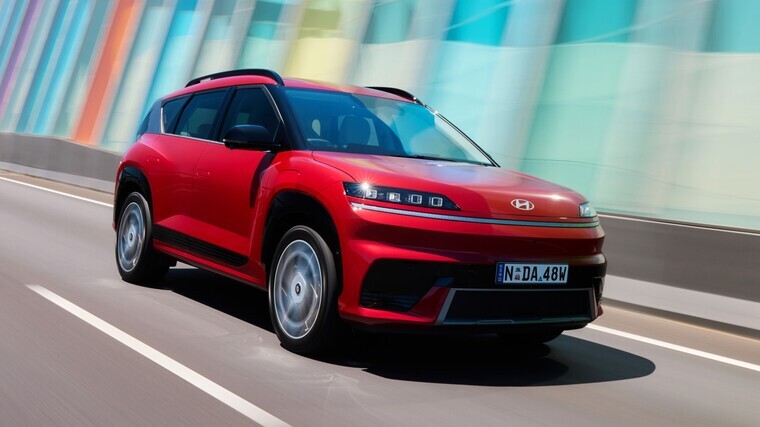
Donaldson’s comments to CarExpert come after his media address for the launch of the Elexio, pictured.
Hyundai’s hybrid sales climbed by 92.8 per cent in 2025 to 28,851 units in Australia last year. It was second behind Toyota on 115,953 units and ahead of GWM with 11,198.
Leading the charge were the mid-size Tucson with 10,556 sales and the Kona on 10,407 with hybrid variants accounting for 52.4 and 45.7 per cent shares of overall registrations respectively across each nameplate.
The Tucson and Kona were Australia's fourth and fifth most-popular hybrids last year behind three Toyotas – the RAV, Corolla and Corolla Cross, which all moved to hybrid-only in the past 18 months.
Hyundai’s larger Santa Fe managed 81.8 per cent hybrid share at 5,125 units in 2025 and was the next non-Toyota model in the top 10 best-selling hybrids.
The Australian government released the first results of its NEVS in February with about two-thirds of manufacturers beating their emissions targets.
Type-one vehicles – passenger cars and SUVs – had a headline limit of 141g/km of carbon dioxide (CO2) emissions for 2025. The headline limit for type-two vehicles, such as utes, vans and large off-road SUVs, was 210gCO2/km.
Hyundai posted an interim emissions value of 84,563 units. That means it will need to trade credit units with another car company by December 31, 2027, or risk a penalty in February 2028 of $50 multiplied by its final emissions value.
Donaldson attributes the marque’s NVES performance to its popular N Division high-performance products, which apart from the electric Ioniq 5 N are powered by high-performance ICEs with figures above headline CO2 caps.
That said, it has committed to its halo performance products, indicating increased hybrid and EV sales are key to balancing out its NVES penalties.
The futuristic Elexio, meanwhile, has joined Hyundai Australia’s expanding electric portfolio, The five-seater is sized between the Kona Electric and Ioniq 5.
The model was launched across the ditch on February 23 with the Elite variant. Boasting a 160kW and 310Nm motor driving the front wheels and an 88kWh lithium iron phosphate battery, it has a WLTP range of 546km. An entry-level version will join the Elite in 2026’s second quarter.
Donaldson says the Elexio reflects Hyundai’s 35-year commitment to developing EVs, and “advancing intelligent mobility solutions that make everyday driving smarter, cleaner and more rewarding”.