


Call for stronger clean car rules
An industry group is calling on the government to publicly commit to keeping and strengthening the clean vehicle standard (CVS) after a “clear majority” of consultation responses supported the scheme.
Drive Electric has made the request and others in an open letter sent to Chris Bishop, Minister of Transport, as the coalition is expected to announce soon whether to change the standard or axe it.
The supply-side policy was introduced in January 2023 and has recently been the subject of a targeted consultation that included the automotive industry, overseas organisations, government agencies and advocacy groups.
Officials have provided their advice to Bishop after the first-principles review and cabinet was expected to decide on the fate of the CVS in June, but industry is still awaiting an announcement.
Kirsten Corson, Drive Electric’s chair, highlights three key requests for the government. These are to publicly commit that the CVS will remain, ensure the current review accelerates energy resilience and security, and to align the standard’s targets and penalties with Australia’s New Vehicle Efficiency Standard (NVES).
She notes Drive Electric staff have reviewed the CVS consultation responses and “were heartened to see the clear majority were in support of keeping the standard”.
“Drive Electric is asking the government to commit to maintaining and strengthening the standard,” she writes.
“The Strait of Hormuz crisis added significantly to what Kiwi families and businesses pay for fuel, with petrol up 18.6 per cent and diesel up 42.6 per cent in March 2026 alone – the largest monthly increases since Stats NZ began recording this data in 2011.
“The CVS is our one policy lever for shifting the vehicle fleet onto our 88 per cent renewable electricity.
“The standard could be aligned with Australia’s NVES, which the Australian Government has confirmed is delivering results.”
Corson’s letter, which was released to media on July 27, explains clean car policies helped drive the combined market share of EVs to more than 20 per cent in 2023.
Since the present government repealed the Clean Car Discount, twice weakened the CVS and applied road user charges (RUC) to EVs, that share fell below 10 per cent by 2025, “while Australia pushed past us”.
In 2024, the government also said changes to the CVS aimed to align the scheme with Australia’s regulations.
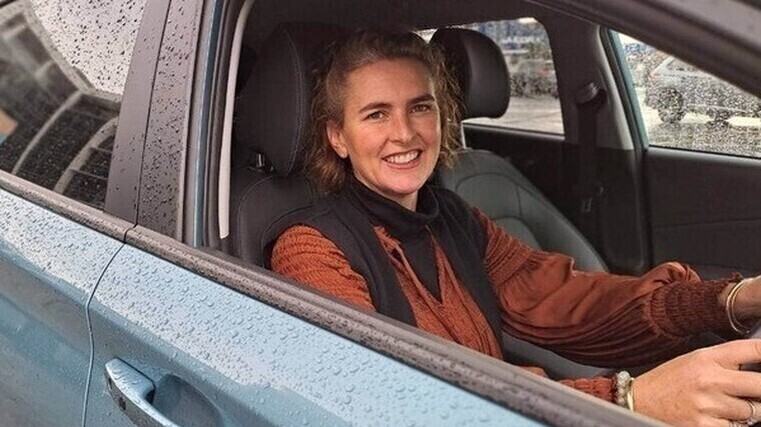
“Since then we have further weakened the standard so now the carbon dioxide penalty here is just $15 per gram, against Australia’s AU$50-$100 [about NZ$60-120] per gram,” opines Corson, pictured, in her correspondence.
“Australia is making this work as evidenced by your equivalent Australian Minister Catherine King, who is reported to say environmental and market objectives can co-exist.
“Weaker EV supply was a consequence of weaker demand policy, not its cause; removing the standard further will only deepen it.”
Corson tells Bishop the domestic demand for zero and low-emissions models is evident, with monthly battery EV (BEV) registrations more than tripling year-on-year in March 2026 alone. Combined BEV and plug-in hybrid (PHEV) sales accounted for 33.6 per cent of new light vehicle sales that month.
She adds even with RUC applied to all 138,600 EVs on our roads, “running one remains 25-50 per cent cheaper than an equivalent petrol car”.
“A 2026 Sustainable Business Council/Climate Leaders Coalition report put the GDP upside of a successful transport transition at $22.6 billion to $33.6b a year by 2050 – citing policy uncertainty as the main barrier.”
Drive Electric also warns the minister that lower EV uptake creates the risk of more oil shocks for business and consumers.
With no domestic refining, New Zealand depends on Asia for its fuel, spending $7b in 2025, rising towards $10b in 2026 on imports, about 60 per cent of which has transited the Strait of Hormuz.
“Combustion vehicles bought today will still be on the road in 15-20 years, locking in that exposure into the 2040s,” writes Corson.
She adds that is alongside a $10.5b annual social cost from vehicle emissions and a Treasury-estimated $4.4b to $6b exposure from purchasing offshore carbon credits to meet our Paris Agreement commitments, “a bill Treasury’s 2023 modelling put as high as $23.7b under less favourable conditions”.
“We are seeking policies focused on energy resilience and security,” she continues.
“Repealing the standard would signal that New Zealand isn’t serious about energy resilience and would leave the country more exposed to the next oil shock.
“Drive Electric welcomes the opportunity to work constructively with the government on this issue, and would welcome the opportunity to meet with you directly.”