


$112m boost for charging network
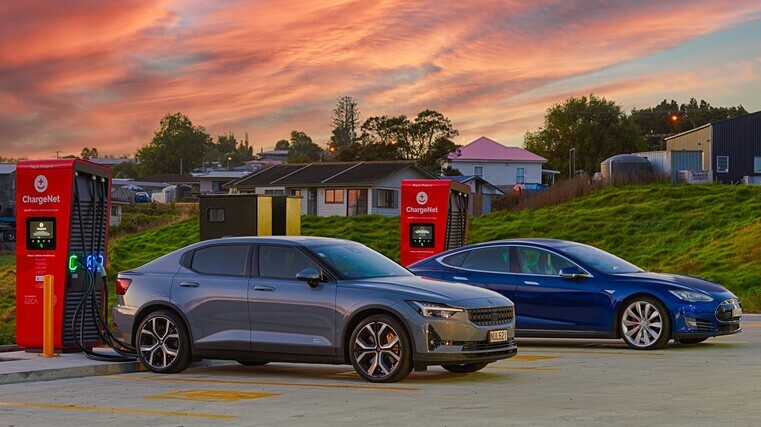
ChargeNet and Meridian have received $52.7 million in government loans to more than double the number of public EV chargers nationwide.
Some 2,574 new charge points will be installed by the companies, which are co-investing a combined $60m of their own capital as part of the project.
About half of the new chargers will be in Auckland, Hamilton, Tauranga, the Wellington region, Christchurch and Dunedin, with the remainder located throughout the regions.
The total includes 1,374 DC fast chargers and 1,200 AC chargers. DC fast chargers deliver power directly to the battery and can charge a car in 20 to 60 minutes, making them suited to highways and destinations where people stop briefly.
AC chargers are slower and better for places where cars are parked for longer periods, such as shopping centres, workplaces and residential areas.
Chris Bishop, Minister of Transport, and Simon Watts, Minister of Energy and Climate, announced details of the zero-interest loans for the two companies on March 23.
“Many New Zealanders have thought about getting an EV, even before the fuel challenges we’re currently facing. But research shows that the lack of public chargers is holding many back from making the switch to an EV,” says Bishop.
“The private sector is reluctant to invest in charging infrastructure until there’s sufficient demand, but demand won’t grow until the lack of public chargers stops putting buyers off.”
ChargeNet and Meridian Energy were selected through a contestable, value-for-money bid process, which has been managed by National Infrastructure Funding and Finance.
Bishop explains the concessionary loans bring forward private investment in public EV charging infrastructure by lowering the cost of capital, while keeping the taxpayers’ contribution to a minimum.
“In this case, the average loan per charge point is $20,000, but once repayments are factored in, the net cost to the Crown is around $10,000 per charger, roughly a quarter of what a direct grant would cost.
“We’re also changing our planning rules to make the installation of public EV chargers a permitted activity under the RMA, meaning in most cases no consent is required – another factor that will help to speed up delivery.”
New Zealand currently has just over 1,800 public charge points, which Bishop notes is among the lowest charger-to-EV ratios in the OECD. Another 161 charge points are also in progress.
The $112.7m co-investment project will take the total to about 4,550. The government is working towards 10,000 charge points by 2030, roughly one for every 40 EVs.
Watts says owning an EV in New Zealand makes financial sense because electricity is cheaper than petrol and mostly generated from renewable sources such as wind, geothermal, solar and hydro.
“Kiwis are already making the shift to electric vehicles as a cost-of-living choice, and we have seen uptake grow,” he continues.
“In February 2026, EV sales were up 10.5 per cent on the same month last year – and anecdotal evidence suggests even greater interest over the past couple of weeks as conflict in the Middle East has seen fuel prices increase.
“A better charging network means more New Zealanders can take advantage of it, and that's good for household budgets and our emissions profile alike. EVs produce at least 60 per cent fewer lifecycle emissions than petrol vehicles.”
‘Reliable access’
ChargeNet has been awarded $37.7m from the public EV charging infrastructure loans programme as part of today’s announcement. It says the money will accelerate its PowerUp vision to rollout more than 1,700 new charging points nationwide by 2030.
Danusia Wypych, chief executive officer, adds the expansion of AC and DC chargers will aim to meet everyday and long‑distance travel needs.
“With over three and a half million charging sessions to date, our DC rapid chargers are ideal for quick top-ups on the go, getting drivers back on the road in as little as 20 minutes,” she explains.
“AC chargers are perfect for longer stays, such as at shopping centres and recreational venues, where vehicles can charge over several hours. So, the two work well together.
“We’re investing in urban and regional sites to ensure reliable access for every journey, whether you’re commuting in the city, travelling between regions, or visiting destinations without home charging.
“EV chargers are critical transport infrastructure, so by offering a range of options we’re making it more convenient and accessible for all New Zealanders.”
ChargeNet’s new charging points will be delivered in partnership with existing site hosts and new partners, including major retailers such as Foodstuffs, recreational venues, and regional and city councils.