


Issues for freight on horizon
Sea and air capacity is set to open up with costs coming down by the middle of 2023/24 although new issues, such as low-carbon freight, will start to dominate the industry in coming years.
These were among the takeaways from the Go Global conference in Auckland held on November 9 with sessions tackling supply-chain bottlenecks created in Covid-19’s wake.
Nick Churton is head of operations at Kotahi – a shipping venture formed after the global financial crisis following a collaboration between Fonterra and Silver Fern Farms.
He said shipping from the bottom of the South Pacific was still reasonably attractive for shipping lines, but “what and how often and how frequently services run [is] probably the big challenge in this space, particularly when you look at the new IMO [International Maritime Organisation] regulations coming in over the next few years”.
For example, a new IMO strategy aims to reduce the carbon intensity of international shipping by 40 per cent by 2030, and by 70 per cent by 2050, when compared to 2008.
Its plan will see ships calculate their emissions per tonne of cargo carried per distance travelled and the number will need to be below maximum levels for a ship of its size and category. This initiative will add cost to shipping.
As for capacity, Churton said the situation had changed from the height of the pandemic when 99 per cent of all goods came to New Zealand on ships and when people stuck at home were spending online much more.
He added demand was softening, with the macro trends of falling consumer confidence, inflationary pressure and geopolitical headwinds, including Russia’s invasion of Ukraine.
On the supply side, he said the integrity of goods delivered when scheduled was improving – from about 35 per cent globally in the past 12 months to almost 50 per cent in the past three months.
“We’re starting to see some softening in the pricing market globally, particularly on the spot market. If we translate that into what we think the next 12 to 18 months looks like, it is very much pressure coming off.
“A number of global shipping lines say peak pricing has passed, so we should see a sort of decline coming through, and continued improvement and schedule reliability is bringing more capacity.”
The government, meanwhile, is working through an issues paper released on future-proofing the supply chain to help the sector cope with disruption, as well as new rules and low-carbon logistics.
A Ministry of Transport (MoT) executive told delegates shipping and logistics was a “market-led sector” and was one that “didn’t want the government to intervene in too much”.
Harriet Shelton, the MoT’s supply-chain strategy manager, said the consensus of thousands of industry players was the government “needed to be able to facilitate the way the sector needs to transform, but not in a way that ends up with us intervening too much”.
She added: “Pretty much anything we do to improve the way the sector works is going to come at a cost, and so that’s a difficult issue to grapple with when we all know customers are not necessarily willing to pay those extra costs.”
The issues that needed to be overcome include more infrastructure, building redundancy into the system to cope with disruption, better technological uptake for the many small businesses that comprise the bulk of the freight sector, and low-carbon options.
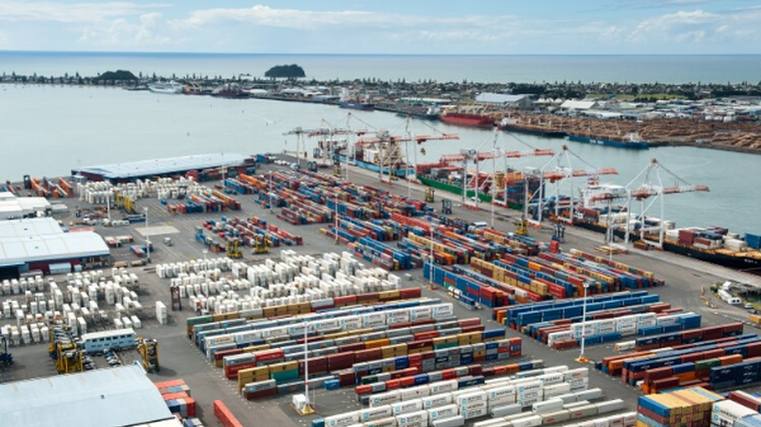
“Social licence is another huge theme. We’ve seen issues like the Port of Tauranga berth extension that has really struggled to get support that provides the capacity badly needed.”
The government is now working on a national freight supply-chain strategy. Some parts are slated to come out in the middle of next year. It is anticipated these will dispense with “tinkering”
with parts of the system and instead try to take a wider view to help supply chains cope.
As for air-freight capacity, DHL’s vice-president of commercial, Selina Deadman, said its 5,000 to 8,000 export customers were telling the company there were still a lot of challenges in the global supply chain.
These are not just in terms of cargo capacity, but also when trying to get their raw products in from overseas to re-export.
Dedman added exporters still didn’t always understand how global events affected supply chains. For example, fuel has gone up as a result of the conflict in Ukraine and costs escalate because cargo flights can’t now fly over Russia so they need more fuel on-board to counteract that.
“There’s still a huge constraint on air freight capacity, which I don’t think we will see change next year, to be fair.”
This is an edited version of a story that first appeared on NBR. Click here to access it.