


Hyundai keeps noise down
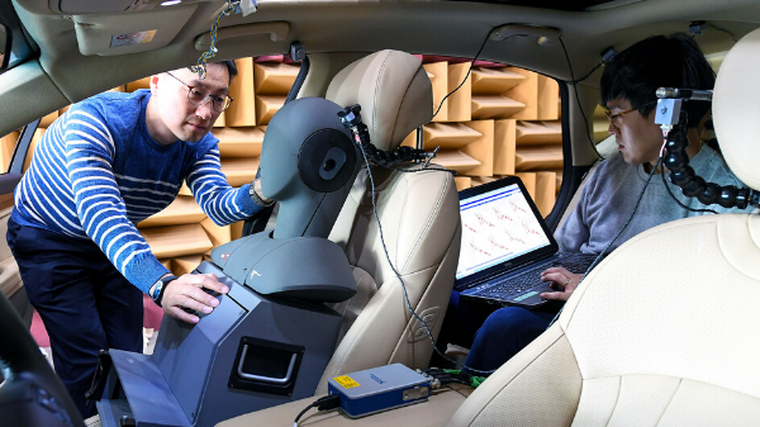
Hyundai Motor Group claims to have developed the world’s first Road Noise Active Noise Control (RANC) system, which aims to cut noise within the cabin of a vehicle.
RANC builds on the group’s Active Noise Control (ANC) technology, which reduces noise by emitting sound waves inverted to incoming noise. ANC is a software-driven system that analyses the in-cabin sound to cut engine and road noise, as opposed to the passive method of blocking noise through sound insulation.
Hyundai claims ANC utilises lighter parts than conventional methods, such as microphones and controllers, to control noise more efficiently. With the RANC technology, the company says it is able to improve in-cabin quietness. The new system analyses noise in real time and produces inverted sound waves. For example, there are different types of road noises that the new technology can process, such as resonant sounds created between tyres and wheels or rumble sounds from the road.
Using an acceleration sensor, RANC calculates the vibration from the road to the car and the control computer analyses road noise. As its computation and signal transfer speeds are optimised, it only takes 0.002 seconds to analyse the noise and produce an inverted sound wave, which is generated by the DSP (digital signal processor). The microphone constantly monitors the road noise cancellation status and sends the information to the DSP. RANC is able to conduct noise analysis and computation to combat road noise for the driver’s seat, the passenger seat and rear seats separately.

Based on tests, Hyundai says RANC was able to reduce in-cabin noise by three decibels, which is roughly half the noise level produced without RANC. The technology has been through six years of research and development before being ready for mass production.
“RANC is a remarkable technology which takes existing NVH [noise, vibration and harshness] technology to the next level,” said Gangdeok Lee, a research fellow of NVH Research Lab. “We will continue to take the leading position of NVH technology and deliver the highest level of quietness to customers.”
The new system is set to be applied to an upcoming Genesis model.