


Greens back tailpipe emissions tests
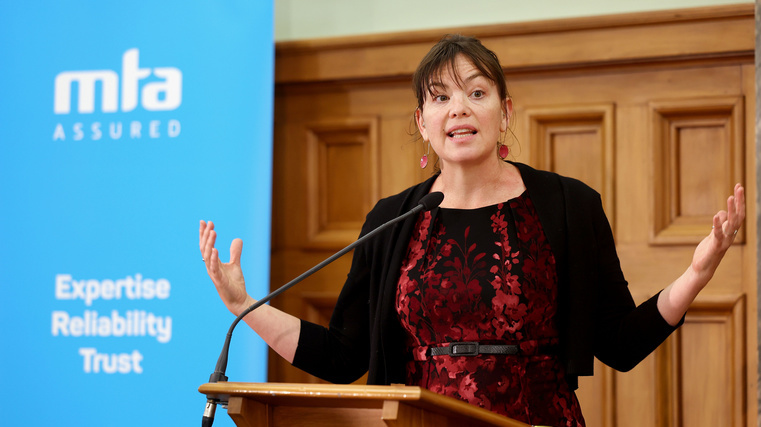
The Green Party has backed a call issued by the Motor Trade Association (MTA) to introduce in-service emissions testing to reduce pollution coming out of tailpipes of New Zealand’s existing fleet.
Julie Anne Genter, the Greens’ spokesperson for transport, has endorsed the policy suggestion in the association’s “Driving New Zealand forward – future proofing the automotive industry”.
Essentially, the 44-page document is the MTA’s “call to action” to the next government ahead of this year’s general election. The organisation lobbies in it for a review into the warrant of fitness (WOF) regime to ensure it is fit for purpose and for in-service emissions to be assessed.
“I absolutely agree with the call to bring in mandated in-fleet emissions testing for older vehicles,” said Genter, pictured, at the MTA’s launch event in Wellington on May 9.
“That’s the next step. I encourage you to ask the National and Act parties to support that policy because I suspect they won’t be supporting that.
“I knew that when we got in that we had to deal with vehicles coming in, so that’s why we have the clean car standard and discount.
“But the next step has to be mandating in-fleet testing, especially now the HAPINZ [Health and Pollution in New Zealand] report shows just how costly particulate emissions are to our health.”
Genter added that’s another good reason to look at policies – such as congestion pricing and low-emissions zones in our towns and cities, and particularly in our biggest cities – because that will take the pressure off the country’s hospital system.
“We have a huge number of children suffering from asthma, being hospitalised, having health impacts and a huge number of premature deaths as a direct result of emissions from polluting vehicles in New Zealand. That’s from the older vehicles.”
Addressing someone who she said appeared “sceptical”, she added: “You should look up the report, it’s right there. It’s actually shocking. The researchers had to look at the numbers two or three times because they were surprised at what a huge impact it was having.
“Other countries around the world have realised this. That’s why so many European cities are starting to phase out diesel vehicles in town centres because it turns out that particulate emissions from diesel vehicles are far more damaging to human health than we realised, even 10 years ago.”
In a bid to tackle emissions, the MTA wants vehicles to automatically fail their WOFs if their engine-warning lights are on when inspected. As a first option, it’s calling for mandatory emissions testing for all vehicles more than 10 years old to ensure they travel further on their fuel supply, which would effectively reduce emissions.
In addition, the MTA’s call to action states increasing awareness and education around emissions testing will enable policy for their reduction to be informed. It stresses that pollution produced by many inefficient, older vehicles has been linked to the deaths of thousands of Kiwis.
Clean-car policies
The MTA is calling for New Zealand’s next government to phase out the clean car discount (CCD). It says there is no doubt this policy has contributed to the “positive outcome” of boosting the number of electric vehicles (EVs) and low-emissions models in the fleet.
“However, the parameters of the CCD have unfair and unfortunate social impacts,” it says. The association is also campaigning for targets and goals laid down by the clean car standard (CCS) to be deferred by two years.
However, such actions when it comes to the clean-car programme have not been supported by the Greens.
Genter, who has been an MP for about 12 years, was an Associate Minister of Transport in the previous term of government. Before entering politics, she worked in the transport sector.
She said: “I worked closely with the MTA when I was an associate minister and we were looking at our emissions reduction programme, so I do laud outcomes set out in this paper. I also think we have to be honest about what’s going to achieve the outcomes we want to get.
“It says in this document that the CCD has been part of the huge uptick we’ve seen in low-emissions vehicles that we have seen in the past two years. And that’s true.
“When I was associate minister we researched the most effective policies to get the outcomes we needed. We came to a combination of fuel-economy standards combined with a price incentive. It has worked even better than forecast and that’s really good.
“So, I can’t agree with the assessment that it’s an unfair policy. It’s an incredibly effective policy that’s delivering in terms of emissions reduction and saving money for New Zealanders over the long term as we spend less on fuel.
“I know some people have described it as being unfair. But the reality is most of the fees being paid are on expensive vehicles, high-emitting vehicles. People who buy new-to-New Zealand cars tend to have money, whether they are businesses or individuals or households. It’s fair all of us work together to reduce emissions coming from the fleet.
“If somebody needs a more polluting vehicle, it’s fair they can access that but that they chip in a bit so we can get more lower-emissions vehicles on the road. That’s why it’s a collective policy and it has to be seen in that way.
“If people are really concerned about inequality, as I am, then we need to focus on addressing our tax system – making sure the wealthiest pay their fair share of tax and supporting all New Zealanders to have really good public services, healthy secure housing, making sure we are investing in infrastructure that’s going to work.
“And if you really care about inequality, I would say you could also vote for the Greens as we are campaigning for a more progressive tax system and fixing our social-welfare system and supporting heavy investment in good-quality public services.
“We should retain the CCD, and continue to ensure the standards we bring in ensure we’re upping the level of fuel economy, which cleans up the air, reduces our petrol bills and helps us address climate change.”
Genter added she was passionate about the opportunity to get such better outcomes for New Zealand through a smarter approach to transport.
“We’ve started to make some of those changes. Severe weather events happening right now and that we’ve seen over the past few months are just a taste of what’s to come and why it’s so important we do things differently.
“We have the ability to create less pollution, travel around our town and cities in ways that reduce energy use, that reduce environmental impact, get safer outcomes, that’s more affordable. Right now, our transport system is incredibly costly to New Zealand in many ways.”
The challenge ahead
“Here’s the challenge,” said Genter. “I know all of you care about your whanau, I know you care about your children and your grandchildren, I know you care about the future of Aotearoa New Zealand.
“This election is vitally important. We are facing an ecological crisis that will affect the future of humanity and we only have a few years to take effective action.
“Right now, New Zealand is not pulling its weight. We know things aren’t working perfectly. I would argue that we haven’t gone as far as we can in terms of really seizing the opportunities that are available to us. To really embrace a green economy, one that addresses inequality, that addresses the injustices of the past.
“We can work together to achieve a better future and we can do that through evidence-based policy.
“It’s hard to address the reason why we need certain policies in sound bites in the media. It’s easier for the opposition, and I’m particularly looking at National and Act right here, to argue for the status quo to stir up anger and outrage, and you’re right the current situation isn’t working perfectly.
“But if you look, I promise you the Greens in government have already delivered a lot of really effective policies that have been good and fair for your sector.
“The Greens in government will deliver not just evidence-based policies, but the things that are actually going to achieve the transformation we need so we can have a sustainable society in Aotearoa New Zealand. So, think about the long term, think about your values. We can do this together.”