

Nissan launches Nissan Energy
Nissan has created a vision to make electric vehicles (EVs) more useful to customers by introducing new convenient ways to utilise their batteries’ ability to store and share energy.
Under the plan, called Nissan Energy, owners of Nissan’s EVs will be able to easily connect their cars with energy systems to charge their batteries, power homes and businesses or feed energy back to power grids. The company will also develop new ways to reuse electric car batteries.
Nissan has already begun programs in the US, Japan and Europe aimed at creating an “ecosystem” around its range of EVs, including the Nissan Leaf, the world’s best-selling electric car.
“Nissan Energy will enable our customers to use their electric cars for much more than just driving – now they can be used in nearly every aspect of the customer’s lives,” said executive vice president Daniele Schillaci. “Our Nissan Intelligent Mobility vision calls for changing how cars are integrated with society, and Nissan Energy turns that vision into reality.”
Nissan Energy will establish new standards for connecting vehicles to energy systems through three key initiatives: Nissan Energy Supply, Nissan Energy Share and Nissan Energy Storage.
Nissan Energy Supply
Nissan Energy initiatives extend to a variety of locations, including Nissan’s North American headquarters, where Leaf vehicles assist in powering the facilities during peak electrical demand times, anticipating significant cost savings.
In Germany Leaf vehicles are being used as a reserve for the German electricity grid, in an innovative pilot project involving Nissan, technology company The Mobility House, energy supplier ENERVIE and transmission system operator Amprion.
Nissan Energy Share
Nissan has already carried out Energy Share pilot programs around the world, collaborating with several companies and organisations.
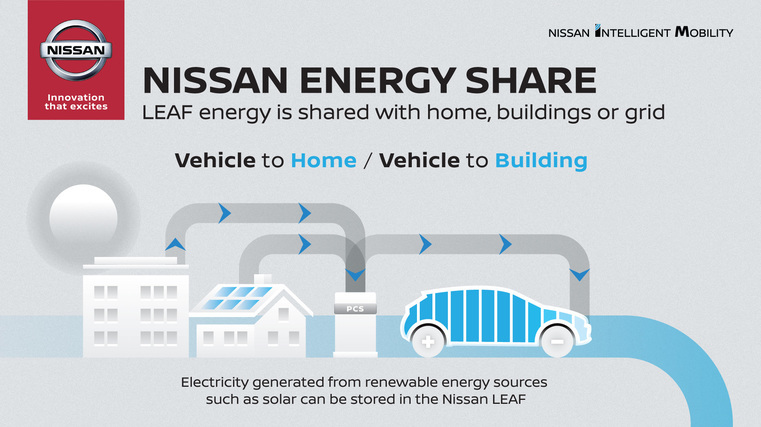
Nissan is working with partners to bring inexpensive equipment to the market to popularise vehicle-to-home (V2H). Using V2H, owners of Nissan EVs can use their cars as a power source for the household to save money on electricity bills, or as backup power during blackouts or emergencies. This allows the usage of renewable energy when available, or when electricity is cheaper.
Similar to V2H, vehicle-to-building (V2B) makes use of EV batteries to store energy for buildings and businesses. However, a V2B system can involve hundreds of vehicles to realise major cost savings for a company.
Full-scale trials of V2B systems have already started in many countries, and Nissan has been working with partners with the aim of bringing the systems to market in 2019.
Nissan Energy Storage
The life of a Nissan electric vehicle’s battery isn’t over after it has finished powering the car.
The battery can be recycled and refurbished for a number of different uses – from powering electric forklifts and generators to supplying energy to a sports arena.
As more and more customers switch to electric cars, the availability of used lithium-ion batteries is expected to increase significantly as owners replace their vehicles.
In Europe, Nissan has been reusing EV batteries as part of an advanced home power solution. In the UK, the company has combined that energy storage with advanced solar panels.
In June, Nissan inaugurated Europe's biggest energy storage system at Holland's Johan Cruyff Arena. Powered by 148 Nissan Leaf batteries, the system operates independently from the main power grid.