

Electrified range expands
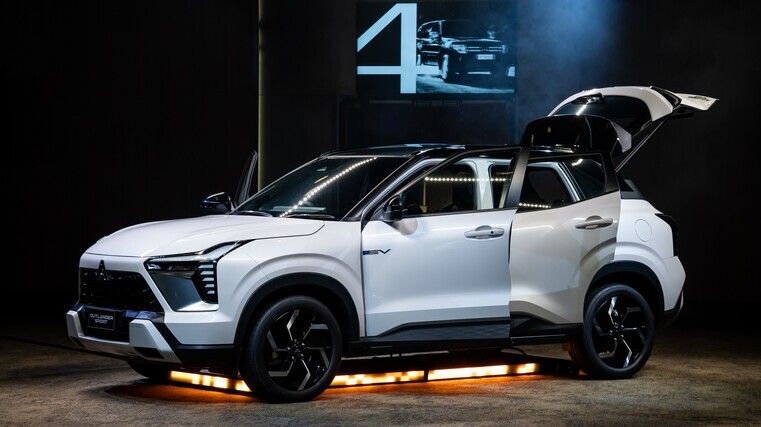
Mitsubishi Motors New Zealand (MMNZ) has unveiled the Outlander Sport HEV to its dealer network and head-office team, giving those closest to the brand the first look at the line-up’s addition.
The compact SUV signals a “significant” step forward in the marque’s electrified journey and a “clear response” to shifting demand as more Kiwis turn to electrified vehicles as a lower-emissions alternative.
Known as the Xforce in other global markets, the Outlander Sport has already proven its appeal with more than 62,000 units sold across Asia, Latin America, Africa and the Middle East since its debut in 2023.
Now, with its introduction to New Zealand in hybrid electric vehicle (HEV) form, MMNZ is bringing a new kind of electrified option to market “to meet growing interest in fuel efficiency and lower emissions without the need to plug in”.
Tony Johnston, chief operating officer of MMNZ, says the timing reflects changing customer priorities and a broader transition. “We’re seeing more New Zealanders looking at electrified options, but not everyone is ready to make the jump to fully electric or plug-in hybrid vehicles [PHEVs].
“The Outlander Sport HEV gives customers a highly efficient, practical SUV that delivers the benefits of electrification in a way that fits into everyday life.”
While Mitsubishi has long been a leader in the PHEV market led by the Outlander’s success, the Sport HEV marks the brand’s first step into petrol hybrids here.
The system pairs a 1.6-litre MIVEC engine with the marque’s latest-generation hybrid technology, automatically switching between EV, hybrid and engine drive modes. It incorporates multiple hybrid operating modes, including parallel and series hybrid configurations, with the system automatically selects the most efficient set-up based on driving conditions and battery charge.
Designed to maximise electric drive, the SUV uses regenerative braking and intelligent energy management to reduce fuel consumption while maintaining smooth performance.
“The strength of this system is that it does the thinking for you,” says Johnston. “It’s constantly adapting to how and where you’re driving, so you get the efficiency benefits of electrification without needing to change your habits.”
‘Pivotal’ year for brand
The arrival of the Outlander Sport HEV is the beginning of what’s shaping up to be a “landmark” year for Mitsubishi in New Zealand.
Already the third most popular automotive brand in the country – and second in passenger vehicles – MMNZ is preparing to introduce a wave of models in 2026 including a “leading edge” battery electric vehicle (BEV) and another key model.
“These models will open the door to entirely new segments,” says Johnston. “It’s about making sure we’re offering the right vehicles for where the market is heading while continuing to build on the strengths that have made us such a popular choice for Kiwis.
“The ASX continues to play a key role in our line-up and remains a popular option for customers. The Outlander Sport HEV sits alongside it, giving buyers another choice in the compact SUV segment.”
The Sport HEV is scheduled to arrive on our shores in 2026’s third quarter with pricing and full specifications to be revealed closer to launch. Ahead of its official arrival, the only example here be on public display at Fieldays at Mystery Creek from June 10-13.
.jpeg)
About the Sport hybrid
Developed with everyday usability in mind, the Outlander Sport HEV combines compact SUV proportions with practicality and capability.
Its “silky and solid” design concept blends a “modern aesthetic with a strong stance”. The XLS and VRX are available in monotone colours, from bold finishes such as volt yellow to more understated tones like graphite grey – while the VRX also offers two-tone options with a contrasting black roof.
Ground clearance comes in at 212mm, while Mitsubishi’s latest platform architecture – with increased body rigidity, optimised weight distribution and finely tuned suspension – delivers a comfortable ride across different conditions.
Selectable drive modes – including normal, wet, gravel and mud – are tuned to optimise traction and stability across various surfaces while delivering responsive electric-drive performance with refined “linear acceleration” providing immediate power delivery.
Inside, a wide instrument panel creates a more open cabin feel. It’s supported by a 12.3-inch display system with wireless smartphone connectivity, and a digital driver display providing data on real-time energy flow, EV driving ratio and regeneration data.
An expansive panoramic glass roof, standard across the range, enhances the sense of space and light in the cabin, while extra soundproofing makes for a quieter ride.
Advanced safety features – including adaptive cruise control, forward-collision mitigation, blind-spot warning and rear-cross traffic alert, and the addition of leading car-departure notification – come as standard. VRX models have a multi-around view monitor and moving-object detection.