


Battery fire fears grow
Marine insurers are increasingly concerned about the scale of risk battery fires on container ships and vehicle carriers.
The frequency of such incidents has been growing and insurance companies fears safety regulations may be lagging.
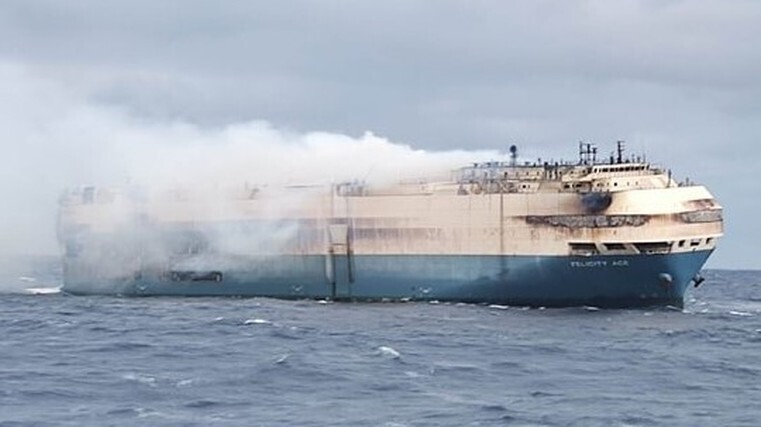
At least three vehicle carriers have been lost this decade – the Höegh Xiamen in 2020, Felicity Ace in 2022, pictured, and the Morning Midas in 2025. A wide range of other ships have also been severely damaged but were salvable, including the Fremantle Highway in 2024, another roll-on, roll-off.
“I don’t think there will be one technology or extinguishing medium that solves every scenario,” says Singapore-based Akshat Arora, regional loss prevention director of the UK P&I Club, which serves shipowners, charterers and offshore operators.
He believes vessels need better prevention, earlier detection, effective containment and cooling, and well-trained crews who understand the limitations of on-board systems.
Arora says the issues aren’t limited confined to container ships and vehicle carriers despite these ship types being susceptible to cargo fires.
Ro-ro vessels, bulk carriers and general cargo vessels are also at risk. Batteries may be present in cars and scrap cargo, while and liner ships also carry a wide range of products that may contain batteries.
Risk exposure shouldn’t be viewed solely in terms of vessel type because battery energy-storage systems now pose a new risk – the aviation industry has imposed restrictions on their carriage.
Lithium-ion requires a new approach. Thermal runaway – the process in which an uncontained chain reaction in a battery causes fire and heat to spread exponentially – cannot be managed by conventional fire-fighting systems on ships.
Although water is effective for cooling and can be important in limiting the spread of heat to neighbouring cells, cars or cargo, getting sufficient water to the right location remains a challenge.
The damaged battery can be enclosed inside a vehicle or a sealed container.
New regulations are taking shape but still fall short of what’s needed. Akshat highlights Special Provision 188, a regulatory requirement in cargo transport safety codes – the IMDG Code in shipping – that limit the size of cells and batteries per item of cargo.
However, there’s no equivalent limit on the quantity of qualifying batteries loaded into a single cargo transport unit (CTU), for instance.
He says: “This means a container can carry a substantial concentration of individually compliant batteries without the dangerous-goods transport documents or CTU placarding that would ordinarily make the hazard more readily visible in the transport chain.”
The International Maritime Organisation’s sub-committee on carriage of cargoes and containers considered the matter in September. Several flag states supported by industry organisations and P&I Clubs drew attention to the absence of a CTU-level safeguard under this guidance.
A revision of this to include a threshold above which extra specified dangerous-goods documents should be required was proposed. But the next revision of the International Maritime Dangerous Goods (IMDG) Code is not due until 2030.
Meanwhile, the IMO’s sub-committee on ship systems and equipment finalised draft amendments to SOLAS on portable infrared thermal imagers and water-mist lances, and design and performance guidelines in March 2026. SOLAS is the International Convention for the Safety of Life at Sea.
“Lithium-ion batteries are now an important part of modern trade and the energy transition,” Akshat told Seatrade Maritime News. “The aim isn’t to make their carriage more difficult, but to ensure they are carried with the right information, appropriate safeguards and preparedness that reflects the risk.”